

Trump internet hosting uncommon Camp David Cabinet assembly — together with outgoing Tulsi Gabbard — as Iran peace talks stall
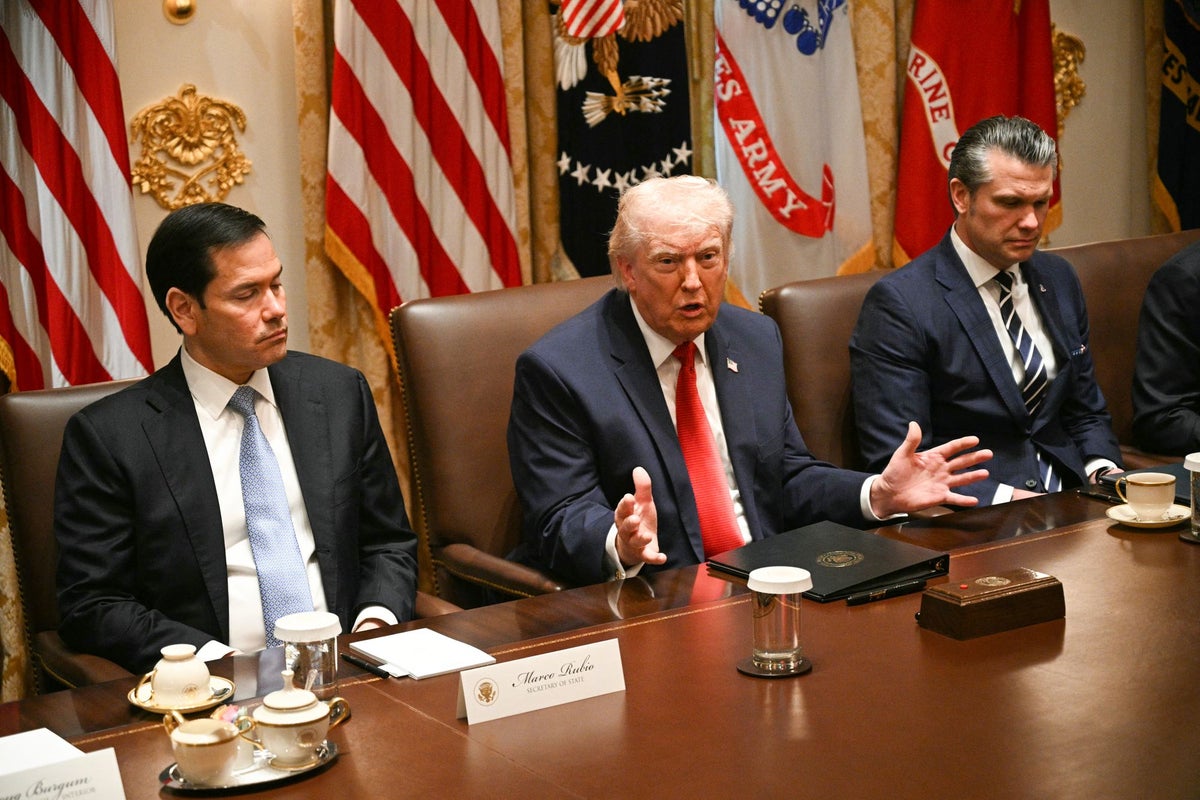
President Donald Trump will host a Cabinet meeting at Camp David on Wednesday, one day after his annual physical at Walter Reed Medical Center and during high-stakes peace talks with Iran that seemed on Tuesday to be breaking down once again.
A White House official confirmed to The Independent that the president’s entire Cabinet would be in attendance — including departing director of national intelligence Tulsi Gabbard, who has taken a back seat in the administration amid the war with Iran and whom Reuters reported last week is being “forced out” of her position by White House staffers.
The official added that the meeting — which generally devolves into a fawning roundtable of the secretaries offering Trump their thanks and praise — would include discussions about “recent successes of the administration including economy and small business wins, Task Force to Eliminate Fraud highlights, and foreign policy updates.”
Over the weekend, chatter grew in Washington around the likelihood that the U.S. was finally within reach of a peace agreement to end the war that has now lasted nearly three months after initial projections from the administration suggested that it would be over in “days”, a prediction Secretary of State Marco Rubio repeated to journalists on Tuesday as he continued a trip to India.
“It’ll take a few days. The president’s expressed his desire to make it — he’s either going to make a good deal or no deal,” Rubio told reporters.
But a renewed round of U.S. strikes against Iranian boats and missile launch sites on Tuesday was met with condemnations from the Iranian government and accusations of ceasefire violations, which could mean that those talks are once again breaking down. White House officials have said for days that the sticking point remains the Strait of Hormuz, as well as Iran’s long-term nuclear ambitions — the latter of which has been a point of divide since before the war began.
The war with Iran now overshadows much of the president’s domestic policy agenda. Its unpopularity and the conjoined effects of the economic crunch caused by Iran’s closure of the Strait of Hormuz have become weights around the necks of Republicans as midterms approach in the fall and the White House attempts to achieve a few last policy wins on Capitol Hill before lawmakers are fully immersed in campaign mode.
The continued rising cost of oil threatens to put a massive damper on Americans’ summer plans, while also making prices in other sectors of the economy rise at precisely the worst time for Donald Trump.
With lawmakers coming back to the Hill next week, the White House and broader administration are set to re-engage Congress in an attempt to reset the relationship between Legislative and Executive branch officials.
Congress departed Washington at the end of last week in a state of open revolt: Republicans in both chamber were thumbing their noses at the White House, in some cases publicly, over a diverse set of issues including the Iran war and plans for a $1.776 billion “slush fund” set to be used by the administration to award “targets” of the Department of Justice’s prosecutions during Obama and Biden eras.
It’s a rough dynamic for any president, and one that comes for Trump as he is seeking passage of that “slush fund” and other priorities through Congress — including, most importantly, funding for ICE’s enforcement and removal efforts that was stripped out of legislation to reopen the Department of Homeland Security when it became clear that negotiations over ICE reforms between Republicans and Democrats were going nowhere, in large part due to Trump’s defiance.
That ICE funding is due to headline the GOP’s second attempt at a budget reconciliation bill. Reconciliation, a Senate budgetary process that allows the chamber to bypass the 60-vote filibuster threshold, represents the only hope for Republicans to pass ICE funding without Democratic support through the upper chamber, and as a result the president’s team is trying to push through ICE funding, the “slush fund”, and even potentially funding for Trump’s planned White House ballroom through the same process that last year produced the “Big, Beautiful Bill”.
Republican senators balked at a meeting with Acting Attorney General Todd Blanche over the weaponization fund on Thursday, however, and as a result the caucus doesn’t believe they can muster even 51 votes to pass this newest list of Trump’s priorities if it is seen as containing a handout to Trump’s friends and political allies. Firsthand accounts from senators inside the meeting indicated the mood was tense, and former Republican Senate majority leader Mitch McConnell issued a statement harshly condemning Trump’s “slush fund” after it concluded.
The House GOP caucus is faring little better. Like the Senate, the House scuttled votes at the end of last week after it became clear that discontent was growing among Republicans in the chamber, and a scheduled War Powers vote meant to restrict Trump’s war-making abilities in Iran was called off after it looked like it would pass the second chamber of Congress in a week — the measure passed the Senate last week after Sen. Bill Cassidy defected and joined with Democrats and other wayward Republicans to hand the White House a defeat.
With the situations involving both Iran and Capitol Hill spinning out of control this week under Trump’s watch, Wednesday’s meeting could be a crucial moment for the president to reassume dominance over his party and make one last push for control of the narrative in Washington.
Source: independent.co.uk
