

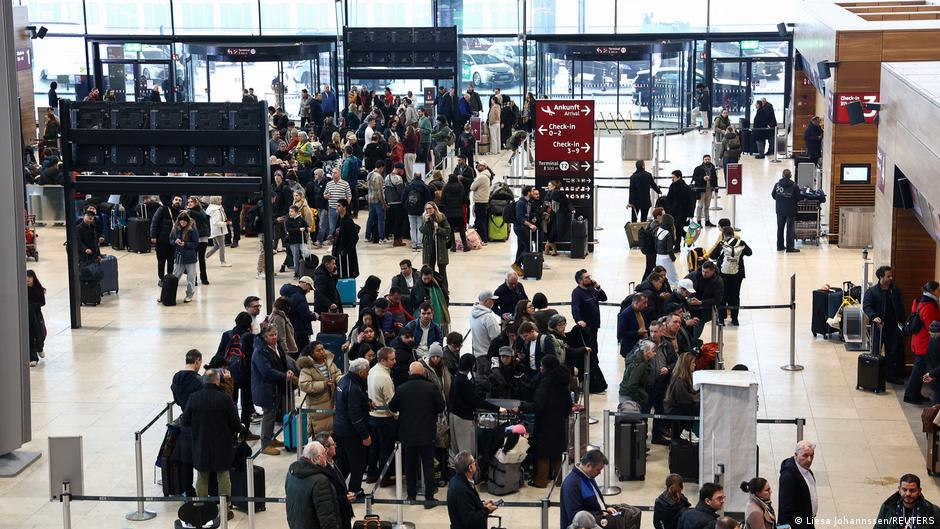
Germany information: Strike to dam all flights at Berlin airport
March 16, 2026
Germany’s ruling coalition to face several election tests in 2026
The first of five state elections this year has already taken place in Baden-Württemberg, where Chancellor Merz’s CDU lost out narrowly to the Greens.
But there are still four to go, with the far-right Alternative for Germany (AfD) party under particular scrutiny as its popularity grows across the country, particularly in the eastern states that formed part of former communist East Germany.
Here is a rundown of the votes still to come in Germany’s Super Election Year, with all dates still provisional:
Rhineland-Palatinate (March 22):
The western state of Rhineland-Palatinate is currently governed by a “traffic light” coalition of center-left Social Democrats (SPD, signature color red), pro-business Free Democrats (FDP, signature color yellow) and environmentalist Greens.
Its premier since 2024 has been Alexander Schweitzer, the former state labor minister, who took over from his party colleague Malu Dreyer after she stepped down for health reasons.
At the 2021 elections, the SPD won 35.7%, the CDU 27.7%, the Greens 9.3%, the AfD 8.3% and the FDP 5.5%.
Recent polls have, however, shown a different picture, with the CDU having a narrow lead over the SPD, while the AfD has more than doubled its voter support. The FDP has sunk beneath the 5% hurdle needed for parliamentary representation in the surveys.
Saxony-Anhalt (September 6):
The eastern state of Saxony-Anhalt is governed by a coalition of the CDU, SPD und FDP under CDU Premier Sven Schulze, who took over from his party colleague Reiner Haseloff in January of this year.
In 2021, the CDU was the strongest party, winning 37.1% of the vote, ahead of the AfD on 20.8%. The SPD received 8.4% behind the Left Party on 11%. The FDP received 6.4%, the Greens 5.9%.
A January poll from Insa showed a different picture, with the AfD well in the lead on 39%, followed by the CDU on 26%. The Left Party had 11%, the SPD 8%, the leftist BSW 6%, while the Greens and FDP were both below the 5% hurdle.
Berlin (September 20):
The city-state of Berlin has been governed since 2023 by what is traditionally dubbed a “grand coalition” of the CDU and SPD under its governing mayor, Kai Wegener, who holds the same rank as other state premiers.
In a repeat election held in 2023 after a 2021 was declared invalid, the CDU received 28% of votes, the SPD and Greens 18.4%, the Left Party 12.2 and the AfD %9.1. The FDP again slipped below the 5% hurdle.
A February poll by the Insa institute showed that the AfD has grown in popularity and would receive around 17% of the vote if elections were held now, making it the second-strongest party behind the CDU on 22%.
The SPD was polling at 16%, followed by the Greens and Left Party on 15%.
Mecklenburg-Vorpommern (September 20):
The eastern state of Mecklenburg-Vorpommern, sometimes called Mecklenburg-Western Pomerania in English, is currently governed by a leftist coalition of the SPD and the socialist Left Party under SPD premier Manuela Schwesig.
At 2021, the SPD received 39.6% of the vote, the AfD 16.9%, the CDU 13.3%, the Left Party 9.9%, the Greens 6.3% and the FDP 5.8%.
A recent survey from Forsa shows that the AfD has experienced a huge surge in popularity, with 37% support.
The SPD was on 23%, the CDU on 13%, the Left Party on 13%, the BSW on11% and Greens on 5%. Again, the FDP was below the 5% hurdle.
While you’re here: Every Tuesday, DW editors round up what is happening in German politics and society. You can sign up here for the weekly email newsletter, Berlin Briefing.
