

EU leaders welcome US tone shift in Rubio’s Munich speech
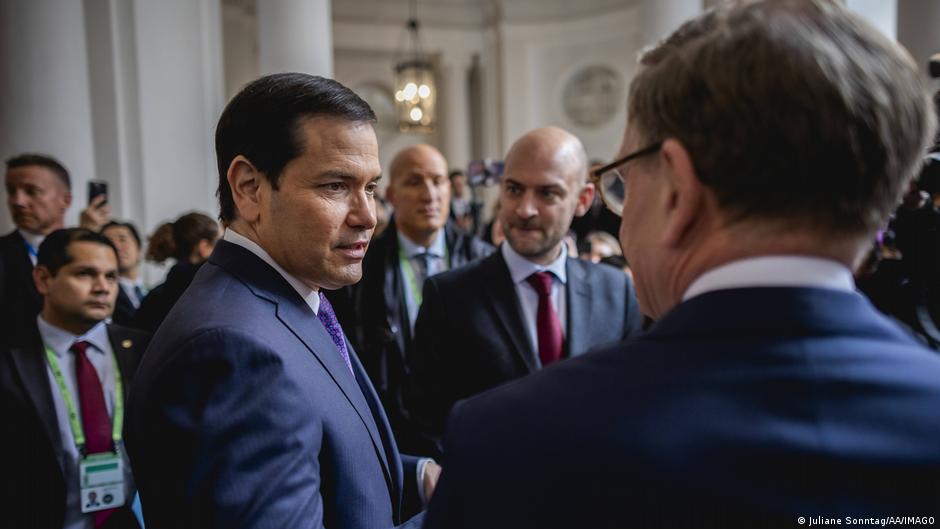
Marco Rubio’s speech at the Munich Security Conference didn’t deviate from the themes of Donald Trump’s second term in office.
Europe, he said Saturday, had to speed up its defense spending and army building.
The US secretary of state warned, as the Trump administration has done before, that Europe risked “civilizational erasure.”
And he espoused a general view that in a new world order, it was nations — not institutions — that get an imperfect world on track.
But his tone was far softer — even warmer — than a year ago when US Vice President JD Vance shook the gathering of world political and defense leaders by lambasting Europe’s approach to free speech, immigration and security.
Though the intervening year has seen fears mount that the US wants out of Europe — with Trump eyeing the Danish territory of Greenland and speaking more openly about a sphere of influence focused more intently on the Americas— Rubio’s speech sought to keep an arm around Europe.
While still asserting a Trumpian view dismissing climate policy and immigration, Rubio cast the US as a “child of Europe.”
He bridged a year of divide by evoking a shared Christian heritage across the Atlantic, and of the European connections that built the US.
Rubio also praised partners in Europe for helping broker peace opportunities for Ukraine, while remaining critical of the UN as a forum for effective diplomacy.
Rubio casts ‘civilization’ at heart of US alliance with Europe
Rubio also continued a consistent theme of the second Trump administration — echoed by other world leaders — that the global order had changed, and positioned the US as a muscular guardian of Western values and culture.
Again, his speech was a less antagonistic approach to the same point made by Vance a year ago.
“We in America have no interest in being polite and orderly caretakers of the West’s managed decline,” said Rubio. “We do not seek to separate, but to revitalize an old friendship and renew the greatest civilization in human history.”
Civilization was an inescapable theme on Saturday morning in Munich, evoked by Rubio a dozen times in his speech and later touched on by his Chinese counterpart Wang Yi, who used the label to describe both China and Europe as partner — not rival — civilizations.
For his part, Rubio sought to keep Europe on the US side of the civilizational theme, describing a shared Western culture that was “unique, distinctive and irreplaceable.” He said it wasn’t “our goal nor our wish” to see the end of the trans-Atlantic alliance.
Cautious welcome of Rubio’s speech
Though a warmer narrative compared to remarks from other US officials, including Trump, since February 2025, Rubio was clearly singing from the administration’s hymn sheet.
He rebuked what he called a “climate cult” amid a US pivot away from the green transition and back toward fossil fuel interests, and said Europe should not fear technology at a time when the EU has sought to assert guardrails against American tech companies.
Those differences were acknowledged by European figures, as they welcomed the US tonal shift.
European Commission President Ursula von der Leyen directly referenced Rubio’s remarks in her speech later Saturday morning, saying that “an independent Europe is a strong Europe. And a stronger Europe makes for a stronger trans-Atlantic alliance.”
She also warned that not all members of Trump’s government share Rubio’s position.
“I was very much reassured by [Rubio]. We know him, he’s a good friend, a strong ally,” said von der Leyen.
“We know that in the [Trump] administration, some have a harsher tone on these topics. But the secretary of state was very clear, he said ‘We want a strong Europe in the alliance.’
Both she and UK Prime Minister Keir Starmer avoided addressing Rubio’s speech in great depth, instead devoting time to talking up a stronger Europe.
“This is what we are working for: not a Europe that is leaning on someone but a Europe that is going forward with friends and allies,” said von der Leyen.
Starmer said Rubio’s remarks were “consistent” with theirs that “Europe hasn’t done enough in its own defense and security for many years.”
German Foreign Minister Johann Wadephul echoed von der Leyen, saying Rubio’s pitch was “a different category to the speech we heard last year [from Vance].”
But Wadephul also acknowledged the importance of German and European independence on defense, climate change policy and trade.
Without directly addressing Rubio’s speech, Chinese Foreign Minister Wang Yi struck a different chord in his address to delegates.
Where Rubio reiterated Trump’s nations-first view on foreign policy and dismissed the UN as an effective arbiter of international relations, Wang called for improved global governance with the UN remaining at the top of the pile of international institutions.
Edited by: M. Kuebler
